AC repair cost in Clermont, FL depends on four things: which part failed, what refrigerant the system uses, how hard the equipment is to reach and whether the visit happens during regular hours or at night. A capacitor or contactor swap sits at the low end of the range.
A compressor or evaporator coil sits at the high end, close enough to replacement territory that the decision deserves a second look.
No honest contractor can price a repair before seeing the system. The way it should work is simple: the technician diagnoses the problem, then gives you the price before any work starts, and you decide.
How a repair call is priced
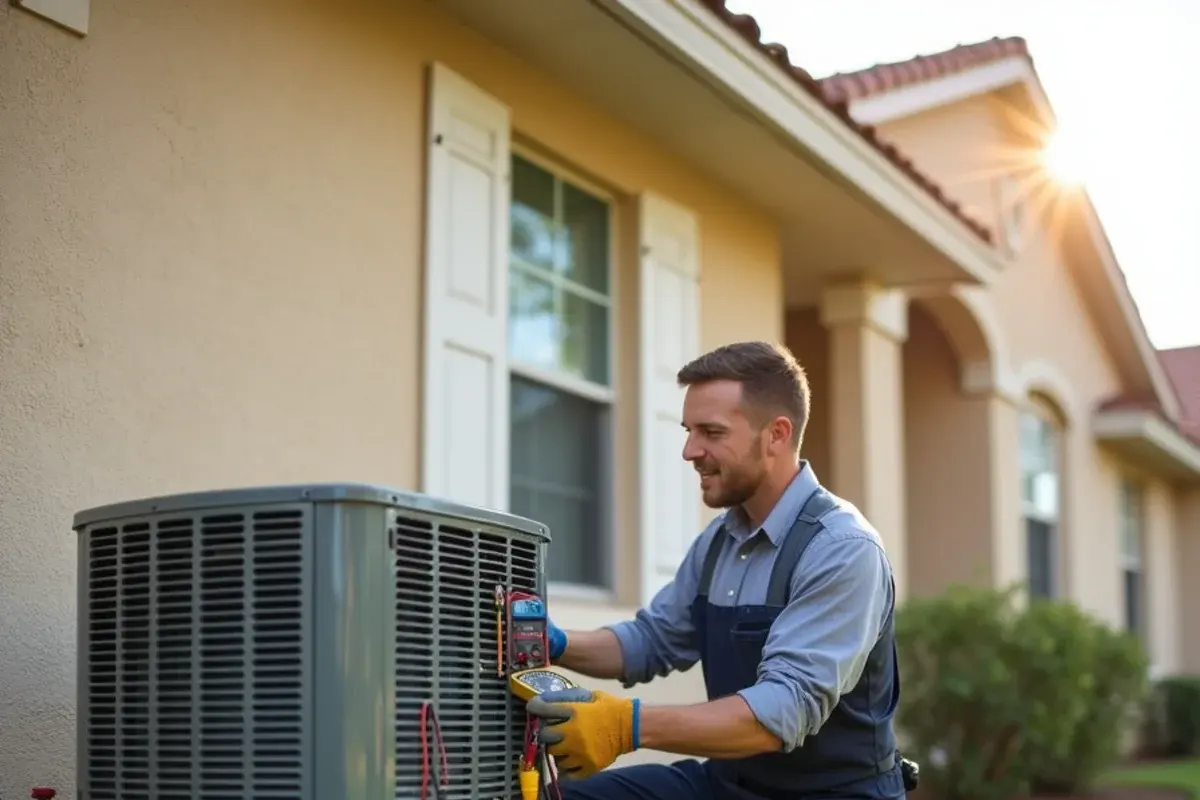
Most repair visits have two parts. The first is the diagnostic visit, which covers the trip and the time it takes to find the fault: checking voltage, testing the capacitor, reading refrigerant pressures, inspecting the drain and the blower. The second is the repair itself, quoted as a single price that includes the part and the labor to install it.
Ask on the phone how the diagnostic visit is handled and whether it is applied toward the repair if you go ahead. Practices differ between contractors, and knowing up front avoids an awkward conversation at the door. With an AC repair in Clermont arranged through us, the technician states the repair price after diagnosis and before work begins.
The part that failed matters most
Parts vary enormously in price and in the labor they take. This is roughly how common Clermont repairs rank, from least to most expensive.
| Repair | What it does | Relative cost | Typical clue |
|---|---|---|---|
| Capacitor | Gives the compressor and fan motors their starting kick | Among the least expensive | Outdoor unit hums, fan does not spin |
| Contactor | Relay that switches power to the outdoor unit | Low | Outdoor unit silent, or runs with the thermostat off |
| Drain line clearing or float switch | Removes condensate and shuts the system off before it overflows | Low | Water in the pan, system shut off |
| Thermostat | Calls for cooling | Low to moderate, depends on the model | Blank screen, wrong readings |
| Condenser fan motor | Moves air across the outdoor coil | Moderate | Fan still, compressor overheating |
| Blower motor (PSC or ECM) | Moves air through the house | Moderate to high; variable-speed ECM motors cost more | No air from vents |
| Control board | Runs the sequence of operation | Moderate to high | Erratic starts, error codes |
| Refrigerant leak repair | Finds and fixes the leak, then recharges | Moderate to high, varies with refrigerant and leak location | Warm air, ice on lines |
| Evaporator coil | Absorbs heat indoors | High | Repeated leaks at the indoor coil |
| Compressor | Pumps refrigerant through the system | Among the most expensive | Breaker trips, loud start, no cooling |
Lightning season shifts the mix. After a summer storm, the calls lean toward capacitors, contactors and control boards, which are usually quick fixes. A capacitor that failed slowly over a hot summer, though, can take a compressor down with it, which is one reason a weak one is worth replacing early.
Refrigerant type and the leak search
Refrigerant is billed by the amount added, so the type in your system has a large effect on a recharge.
- R-22 is in systems installed before about 2010. U.S. production and import ended in 2020, so only recovered and reclaimed supply remains. It is the most expensive refrigerant to add, and a large R-22 recharge is often the point where replacement makes more sense.
- R-410A is in most systems installed from about 2010 through 2024. It is still available for service, though new equipment no longer uses it.
- R-454B and R-32 are the A2L refrigerants in newer systems. Service requires tools and recovery equipment rated for mildly flammable refrigerants.
Topping off a leaking system without finding the leak is money spent twice. A proper leak search uses an electronic detector, bubble solution or a nitrogen pressure test, and it adds time. The repair itself may be a brazed joint at the service valve (inexpensive) or a coil that has corroded through (expensive). Then the system is evacuated with a vacuum pump and weighed in to the correct charge.
Access, timing and the house itself
Where the equipment sits
An air handler in a garage closet can be serviced standing up. One in the attic of a two-story home, reached through a hatch in summer heat, takes longer for the same part, and some repairs (a blower motor or a coil) mean working in a tight space with limited footing. That labor shows up in the quote.
When the call happens
Nights, weekends and holidays usually carry a higher rate than a weekday visit, since the contractor is pulling a technician off-shift. If the house is safe and the checks in our eight-step AC checklist did not help, ask the dispatcher whether waiting until morning changes the price.
Age and parts availability
Common parts like capacitors fit almost anything. Brand-specific control boards, ECM motor modules or coils for a discontinued model can take longer to source and cost more. Systems in the 2005 to 2015 subdivisions we cover for AC repair in Groveland are reaching the age where that starts to happen, and so are the original systems in Clermont neighborhoods of the same era.
How to read a repair quote
A good repair quote is short and specific. Before you agree, it should tell you:
- What failed, in plain terms, and how the technician confirmed it (a capacitor reading below its rating, a seized fan motor, a measured leak).
- The exact part being installed, and whether it is an original manufacturer part or a universal replacement.
- One total price for the repair, with refrigerant shown separately if it is being added by the pound.
- Anything else the technician noticed that is not urgent, listed separately so you can decide later.
Questions worth asking before you approve
- If refrigerant is low, where is the leak, and is it being repaired or just topped off?
- Is the failed part covered by the manufacturer's parts coverage, and does that include labor?
- Did the failure have a cause (a surge, a clogged drain, a dirty coil) that will repeat?
- Given the age of the system, would you put this money into it if it were yours?
That last question matters most on a system over 12 years old. If the answer is uncertain, our guide on whether to repair or replace a 15-year-old AC walks through the decision.
From the field: how homeowners end up paying twice
The most expensive AC repair is the one done twice. Technicians see the same few patterns behind repeat bills, and most of them are avoidable once you know to look.
- The yearly top-off. Refrigerant does not wear out. A system that needs a recharge every summer has a leak, and paying to refill it each year costs more over time than finding and fixing the leak once.
- Parts swapped without readings. A capacitor replaced without a meter test, or a contactor changed because it was easy to reach, can leave the real fault in place. Ask what was measured before a part was condemned.
- Treating the symptom. A float switch that keeps shutting the system off is not fixed by resetting it; the drain line needs clearing and a cleanout tee. The repeat call costs more than the first one would have.
- Paying night rates for a morning job. If the house is warm but everyone is comfortable, ask whether a first-thing appointment makes more sense than an after-hours visit. Real emergencies, such as water through a ceiling or a burning smell, are what 24/7 emergency AC repair is for.
Two habits keep repair bills down. Ask whether the diagnostic fee is credited toward the repair if you go ahead, since many contractors do. And book a spring AC maintenance visit: a cleared drain and a tested capacitor prevent the two most common summer breakdowns in Clermont.
Get a price for your repair: call (321) 478-0693
Call (321) 478-0693 any time, day or night. We send the nearest available HVAC contractor, who diagnoses the problem and tells you the price before starting work. Every HVAC contractor we send is licensed and insured in Florida.
Frequently asked questions
Why won't anyone give me an AC repair price over the phone?
Because the same symptom has very different causes. Warm air from the vents can be a capacitor, a clogged filter, a refrigerant leak or a failing compressor, and those sit at opposite ends of the price range. A contractor who quotes a firm repair price without testing anything is guessing. What you can get over the phone is how the diagnostic visit is handled.
Is a refrigerant recharge a repair?
Not on its own. Air conditioners are sealed systems, so low refrigerant means a leak somewhere. A recharge without a leak repair restores cooling for a while, then the charge drops again and you pay for refrigerant twice. Ask the technician where the leak is and whether it can be repaired, especially on an R-22 system where refrigerant is scarce.
Does a power surge repair cost more than a regular breakdown?
Not necessarily. Surge damage often hits inexpensive parts first: the contactor, the capacitor, a low-voltage fuse or the transformer. A damaged control board or compressor is more costly. Some homeowners check whether their homeowner's insurance covers lightning damage to the system, which is worth asking your insurer about before the repair.
Serving Groveland, FL, Clermont and the rest of South Lake County.