Air duct repair in Clermont, FL usually means reconnecting, strapping and sealing the original attic flex duct, adding return air to rooms that run hot, or replacing runs that are wet, crushed or moldy. A licensed contractor tests static pressure and finds the leaks before quoting, so you pay to fix the ducts that are actually failing.
Most Clermont homes built between the late 1990s and 2010 still run on the builder's attic flex duct, and that duct is now about 20 years old. When a bedroom never cools, vents leave dust behind, or the bill climbs while the system runs nonstop, the ductwork is often the cause. Call (321) 478-0693 and we will send a local HVAC contractor to inspect and test the duct system.
We answer 24/7 and dispatch independent contractors who handle attic duct repair, duct sealing, return-air fixes and complete ductwork replacement in Clermont, Minneola, Groveland and the rest of our South Lake County service area. Every HVAC contractor we send is licensed and insured in Florida. You get the diagnosis and price before work starts.
Signs of Duct Problems: Hot Rooms, Dust, High Bills, Musty Smell
Duct trouble usually gets blamed on the air conditioner. These signs point to the ducts instead:
- One or two rooms that never reach the thermostat setting, usually the ones farthest from the air handler or over the garage.
- Weak airflow at some registers while others blow hard.
- Dust on furniture a day after cleaning, or gray streaks on the ceiling around supply vents.
- Electric bills that climb year after year with no change in how you use the house.
- A musty smell when the system starts, which points to moisture in the ducts or the air handler.
- Registers that sweat or drip on humid summer afternoons.
If the whole house is warm rather than one room, start with our guide to why an AC runs but does not cool, since a failed capacitor or dirty coil is a smaller fix than ductwork.
Attic Flex Duct in 2000s Clermont Homes: Sagging, Crushed and Disconnected Runs
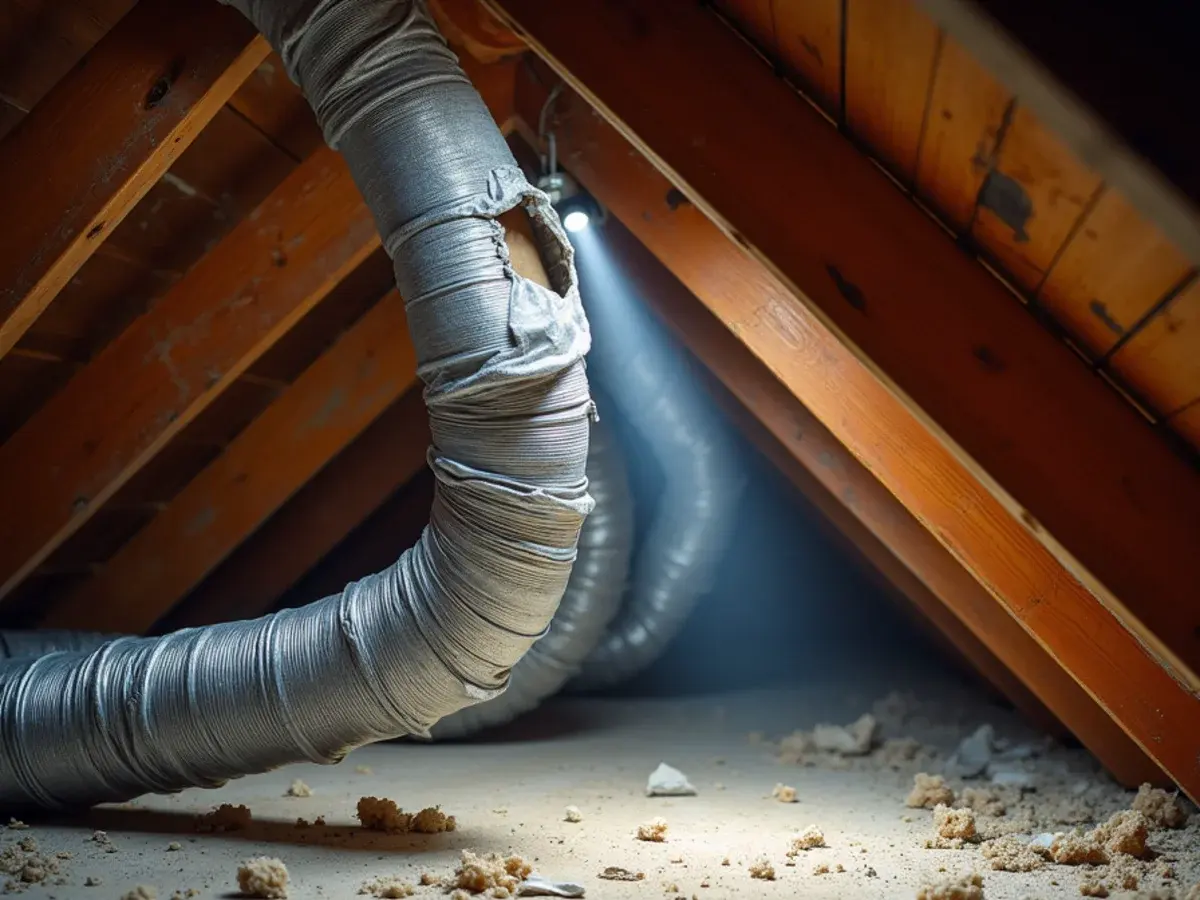
Most homes from Clermont's 1998 to 2010 boom, Kings Ridge and Summit Greens included, got the same layout: a plenum on the air handler and round flex duct across the attic to each ceiling register. Twenty summers in a 130-degree attic wear down the liner, insulation and jacket.
What the contractor usually finds
- Sagging runs from widely spaced straps, which add resistance and collect condensation.
- Crushed or kinked duct from cable, solar or pest crews walking the attic.
- Disconnected joints at the plenum collar or register boot, dumping cold air into the attic.
- Cracked jackets that let humid air soak the insulation.
- Dried-out cloth duct tape that has let go.
A disconnected run cools the attic instead of the bedroom; smaller leaks do the same thing quietly.
Duct Leak Testing and Sealing
Testing finds what inspection misses. The technician measures static pressure at the air handler (many residential air handlers are rated around 0.5 inches of water column, and choked systems read well above it). For leakage, the registers are sealed and a calibrated fan pressurizes the ducts to 25 pascals to show how much air escapes.
Leaking ducts on the return side pull hot, humid attic air and dust into the house, which hurts both comfort and indoor air quality. Duct sealing usually includes:
- Mastic brushed over plenum seams, collars and takeoffs.
- Drawbands to reattach flex duct at boots and collars.
- UL 181 rated foil tape where mastic is not practical.
- New straps to lift sagging runs.
- Sealing boot-to-drywall gaps at each register.
Duct Replacement: When Repair Is Not Enough
Repair works when problems are isolated; once insulation is wet or flattened across the attic, it does not. Ductwork replacement starts with a room-by-room Manual J load calculation and a Manual D duct design, then new R-8 flex duct (the current Florida energy code calls for R-8 on attic ducts 3 inches and larger), a sealed plenum and proper strapping.
| What the inspection shows | Usually repair | Usually replace |
|---|---|---|
| One or two disconnected or crushed runs | Yes | No |
| Leaks mainly at the plenum and collars | Yes, seal with mastic | No |
| Brittle, split jackets on most runs | No | Yes |
| Wet or moldy insulation throughout | No | Yes |
| Rooms undersized by the original design | Sometimes | Often, with a new layout |
If the system is 15 or more years old, replacing ducts during an AC replacement means one attic job and new equipment matched to ducts that can carry its airflow. Our Central Florida AC replacement cost guide explains how ductwork fits into that quote.
Hot Upstairs Rooms in Two-Story Homes: Balancing and Return Air
Hot upstairs rooms are the top duct complaint in Clermont's two-story homes. The second floor sits under the hottest attic air, and one system often serves both floors with ducts that favor the downstairs.
In 2015-and-later builder homes in Clermont and Minneola, the culprit is often an undersized return: closed bedrooms cannot push air back to the system, so supply barely flows. Common fixes:
- Adding a return or enlarging the existing one.
- Jumper ducts or transfer grilles for closed bedrooms.
- Balancing dampers to push more air upstairs.
- Resizing undersized supply runs.
- A ductless mini-split for a bonus room the main system was never sized to cool.
Humidity, Condensation and Mold on Ducts and Vents
A register that drips in July is cold supply air meeting humid air. Usual causes: missing insulation at the boot, a boot-to-drywall gap, low airflow that over-chills the supply air, or an oversized system that short-cycles and leaves humidity high. Indoor humidity above roughly 60 percent feeds mold on grilles and duct liners.
The contractor fixes the moisture source first, then replaces any flex run with mold inside the liner, which cannot be cleaned reliably. Regular AC maintenance keeps the coil and drain pan from becoming the next source.
Duct Cleaning: When It Helps and When It Does Not
Duct cleaning does not fix leaks, airflow or humidity. EPA guidance says routine cleaning has not been shown to prevent health problems and suggests it for visible mold, rodents or insects, or heavy debris from the registers. Brushes can also tear the liner inside flex duct.
| Duct cleaning | Duct sealing | |
|---|---|---|
| What it does | Removes dust and debris inside the ducts | Closes leaks at joints, seams and boots |
| Problems it helps | Debris after renovation, pests, visible contamination | Hot rooms, dust, high bills, humidity |
| Effect on energy use | Little | Often noticeable |
| Best fit | Rigid metal or duct board in good shape | Any duct system with measured leakage |
How a Duct Inspection and Repair Visit Works
- Room-by-room walk-through. You point out the hot rooms, weak vents and dusty registers, and the technician measures supply temperatures and airflow at the worst ones.
- Static pressure at the air handler. One reading on each side of the blower shows whether the duct system is choking the equipment or leaking badly on the return.
- Into the attic. Every run is followed from plenum to boot, looking for disconnected collars, sags, crushed sections, torn jackets and wet insulation, with photos so you can see what was found.
- Options and a written price. Repair, partial replacement or full replacement, explained against the readings, priced before any work starts.
- Repair, then retest. After sealing and reconnecting, the pressures and room temperatures are measured again so you can see the difference, not just take it on faith.
What Affects Ductwork Cost
The contractor inspects and tests first, then gives you a written price before work starts. What moves it:
- Scope: sealing a few joints, replacing several runs, or a full ductwork replacement.
- Home size: number of runs, one story or two.
- Attic access and clearance.
- Return-air changes that need new ceiling or wall openings.
- Design and testing (Manual D, static pressure, leakage).
- Mold or wet insulation removal.
- Permit and timing: full replacement generally needs a mechanical permit, and pairing it with new equipment avoids two attic jobs.
Rental owners near Four Corners can book inspections between guest stays.
Why Choose Sugarloaf Cooling for Duct Repair
- Tested, not guessed. Static pressure and room-by-room readings come before the quote, so a duct fix is not sold to cure what is really a capacitor or a dirty coil.
- Photos from the attic. You see the disconnected collar or the crushed run yourself instead of taking a description on trust.
- Repair before replacement. When straps, drawbands and mastic will fix the problem, that is the first option you hear.
- Permitted when it should be. Every HVAC contractor we send is licensed and insured in Florida. Full replacements are permitted, and duct work can be paired with a system change-out so you only pay for one attic job.
- One number for the whole system. Call (321) 478-0693 24/7; the same call covers the ducts, the air handler and the outdoor unit.
Duct Repair Across South Lake County
Duct problems track the age and layout of the house. The two-story builder homes in Minneola are the classic hot-upstairs case, usually an undersized return. In Groveland, single-story homes from 2005 to 2015 are reaching the age where flex duct liners tear and straps sag. Vacation rentals near Four Corners see crushed runs from attic traffic and can be inspected between bookings. Older homes on large lots around Mascotte sometimes have long runs to additions that were never designed for, and some older homes near downtown Winter Garden were retrofitted with ducts or have none at all. Check your town on the service areas page.
Duct Repair FAQ
Why is one room always hotter than the rest of the house?
Usually the room is not getting its share of air. The supply run may be crushed, sagging or disconnected in the attic, too small for the room's heat load, or the room has no path for air to return when the door is closed. Rooms over garages, rooms with west-facing glass and upstairs bedrooms in two-story homes are the usual suspects. A contractor measures airflow at the register and checks the run in the attic to find the cause.
How long does ductwork last in a Florida attic?
There is no fixed expiration date, but attic flex duct in Central Florida commonly starts to fail somewhere around 15 to 25 years, depending on installation quality and attic traffic. Heat breaks down the outer jacket and tape, and the insulation absorbs moisture once the jacket cracks. That puts most Clermont homes built between 1998 and 2010 in the window where an inspection is worth doing, especially before a system replacement.
Do I need duct cleaning or duct sealing?
Most Clermont homes with hot rooms, dust or high bills need sealing, not cleaning. Sealing closes the leaks that pull dusty, humid attic air into the system and waste cooled air. Cleaning makes sense when there is visible mold growth, evidence of rodents or insects, or debris left after a renovation. If the ducts are flex duct with mold inside the liner, replacing those runs usually beats cleaning them. A leakage test shows which problem you actually have.
Should the ducts be replaced when the AC is replaced?
Not automatically. If testing shows the ducts are sealed, sized correctly and in good condition, a new system can connect to them. If they are original 2000s flex duct with cracked jackets, leaks or undersized returns, replacing them at the same time is usually smarter: the attic is already open, one permit covers the work, and the new equipment gets the airflow it is rated for. Ask for static pressure readings with the quote.
How do I know if my ducts are leaking?
Look for rooms that never reach the thermostat setting, weak airflow at some registers, dust that comes back a day after cleaning, gray streaks around ceiling vents and a bill that keeps climbing. In the attic, disconnected collars, flattened runs and tape that has peeled away are visible signs. The reliable answer is a static pressure test and an inspection of every run, which shows how much air is escaping and where.
Can fixing my ducts lower my electric bill?
Often, yes. When a supply run is disconnected or leaking, you pay to cool air that ends up in a Florida attic, and the system runs longer to make up for it. Leaks on the return side pull in hot attic air, which adds load and humidity. Sealing and reconnecting the ducts cuts that waste, and the improvement is usually most noticeable in two-story homes and older systems that already run long cycles.